Quick Overview
- Audience: IT/security leads, MSP operators, and SMB owners evaluating DNS-layer controls
- Intent type: DNS security platform comparison and implementation decision guide
- Primary sources reviewed: Cisco Umbrella, Cloudflare Zero Trust, NIST CSF 2.0, CISA SMB guidance
Last updated: February 19, 2026
Key Takeaway
Cloudflare is usually stronger on transparent pricing and network performance, while Cisco Umbrella is often stronger for teams that want DNS-first security with enterprise threat intelligence and negotiated contracts.
Best For
- Side-by-side comparison clarifies where DNS-only and broader Zero Trust strategies diverge
- Transparent cost framing includes licensing, support, and implementation overhead
- Deployment complexity and team maturity requirements are clearly separated
- Decision framework maps solution fit by business size and risk profile
Consider Alternatives If
- Final Cisco pricing is still quote-dependent and can vary by negotiation
- Cloudflare feature depth can increase policy complexity for lean IT teams
- DNS controls alone are insufficient without endpoint and identity guardrails
- Tool fit changes as organizations move from SMB to mid-market compliance needs
Executive Summary
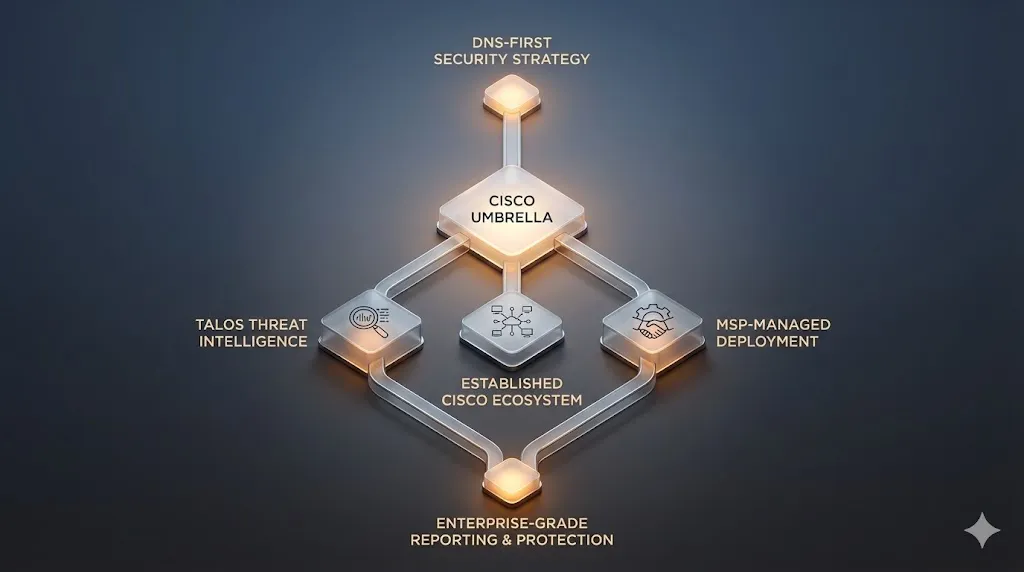
DNS security is one of the most practical first steps a small business can take to reduce exposure to malware and phishing — it blocks threats at the domain level before they reach your network or devices. Both Cisco Umbrella and Cloudflare for Teams deliver cloud-managed DNS filtering, but they serve different buyer profiles.
Cloudflare publishes a unified Zero Trust plan at $7 per user per month, with a free tier for teams under 50 users. Cisco Umbrella uses quote-based pricing negotiated through Cisco's sales team or a Managed Service Provider — street pricing via MSP channels runs roughly $2.25–$3.75/user/month for DNS Essentials up to $5.50–$8.00+/user/month for the full Secure Internet Gateway tier.
The right choice depends on how you buy, how much IT capacity you have, and whether DNS filtering is your only goal or part of a broader Zero Trust strategy. The Decision Framework section below maps each scenario to a recommended path. For a deeper look at Cisco Umbrella on its own, see our Cisco Umbrella Business Review.
How Much Do Cisco Umbrella and Cloudflare Cost?
Cloudflare offers a unified Zero Trust plan at $7 per user monthly, while Cisco Umbrella requires custom annual quotes based on organization size. Both figures are current as of February 2026.
Cisco Umbrella Pricing Structure
Cisco does not publish list prices, but third-party analyst and MSP channel data for 2025/2026 gives a reliable street-price range:
Umbrella tiers (street pricing via MSP channels):
- DNS Essentials: ~$2.25–$3.75 per user/month (domain-layer filtering, basic reporting)
- DNS Advantage: ~$3.75–$5.50 per user/month (adds threat intelligence, cloud-delivered firewall)
- Secure Internet Gateway (SIG): ~$5.50–$8.00+ per user/month (full proxy, CASB, remote browser isolation)
- Cisco Secure Access: Quote-based (SASE/Zero Trust evolution of Umbrella)
Pricing considerations:
- No public list pricing: All quotes come through Cisco's sales team or an MSP
- Annual commitments: Most contracts require a 12-month minimum term
- Negotiable rates: Volume, multi-year, and existing Cisco relationship discounts are common
- Professional services: Setup and onboarding may add 25–50% of first-year licensing cost
- No per-device limits: A single user license covers all their devices
Real-world example (10-person business):
- DNS Essentials: ~$270–$450/month ($3,240–$5,400 annually)
- SIG tier: ~$660–$960/month ($7,920–$11,520 annually)
- Professional services: $1,500–$6,000 additional for initial setup
- Total first-year cost: $4,740–$17,520+ depending on tier and negotiated rates
Cloudflare Zero Trust Pricing Structure
Cloudflare consolidated its Zero Trust pricing in 2025. The fragmented Gateway/Access standalone tiers are no longer the primary offering — the current structure is:
Zero Trust plans (as of February 2026):
- Free: $0 for up to 50 users — includes Gateway DNS filtering, Access application controls, and the full dashboard
- Pay-as-you-go: $7 per user/month — full Zero Trust suite (Gateway, Access, Browser Isolation on higher usage, WARP client)
- Enterprise: Custom pricing — dedicated support, SLA guarantees, extended log retention, and advanced controls
Pricing advantages:
- No minimum users: Pay-as-you-go scales from 1 user up
- Transparent published pricing: No sales process required for plans up to Pay-as-you-go
- Monthly billing available: No annual commitment required on Pay-as-you-go
- Free tier value: Substantial functionality at no cost for teams under 50 users
Important caveat — log retention: The Pay-as-you-go plan includes only 30 days of log retention. Organizations in regulated industries (HIPAA, PCI, financial services) that need 90+ days of audit-ready logs will need to either export logs to a SIEM or upgrade to an Enterprise contract. Factor this into your total cost of ownership if compliance logging is a requirement.
Real-world example (10-person business):
- Free tier: $0 if under 50 users and basic filtering is sufficient
- Pay-as-you-go: $70/month ($840 annually) for the full Zero Trust suite
- Total first-year cost: $840–$1,340 including implementation time (no hidden licensing fees)
Compare DNS Security Pricing
Confirm live pricing and choose DNS filtering coverage based on team risk and support requirements.

NordLayer
Business VPN with zero-trust features • Starting at $8/user/month

Proton VPN
Privacy-first VPN from Proton with Swiss protection • Starting at $4.99/month
Affiliate disclosure: We may earn a commission from purchases made through these links at no additional cost to you.
Implementation and Deployment Times
Basic DNS filtering takes two to four hours to configure on Cisco Umbrella and three to six hours on Cloudflare for Teams. Both platforms require basic network knowledge, but their deployment paths differ as you scale.
Cisco Umbrella Deployment Process
Initial Setup (Cisco Umbrella):
- Time Required: 2-4 hours for basic DNS configuration
- Technical Expertise: Basic network understanding required
- Deployment Steps:
- Account setup and user assignment (30 minutes)
- DNS configuration across devices/routers (1-2 hours)
- Policy configuration and testing (1 hour)
- User training and rollout (1 hour)
Ongoing Management:
- Monthly Time Investment: 1-2 hours for policy review and reporting analysis
- Complexity: Moderate - requires understanding of web categories and threat types
- User Training: Minimal - mostly invisible to end users
Common Implementation Challenges:
- Router Configuration: Some older routers lack DNS override capabilities
- VPN Integration: Requires additional configuration for remote workers
- Application Compatibility: Business applications may require policy adjustments
- Device Enrollment: Cisco Secure Client is the unified endpoint agent for full mobile and roaming protection. The legacy Umbrella Roaming Client reached End-of-Support in April 2025 — meaning 2026 is the first year legacy holdouts are running without security patches. If your organization has not yet migrated to Cisco Secure Client, this is a mandatory action, not an optional upgrade
Cisco Meraki integration: If your office network runs on Cisco Meraki firewalls or routers, Umbrella integrates natively via a single API key entered directly in the Meraki dashboard — no additional agent or DNS redirect configuration required. This makes Umbrella the lowest-friction DNS security option for Meraki shops, and is one of the strongest practical reasons to choose Umbrella over Cloudflare if you are already in the Meraki ecosystem.
SD-WAN and branch office deployments: For organizations routing branch office traffic through SD-WAN, Cisco's Secure Internet Gateway (SIG) tier is designed for this architecture — it can act as the cloud-based security stack for all branch internet egress, replacing the need for per-site firewall appliances. Cloudflare's Magic WAN product covers similar ground but is positioned more toward larger mid-market deployments.
Cloudflare Zero Trust Deployment Process
Initial Setup (Cloudflare Zero Trust):
- Time Required: 3-6 hours for comprehensive configuration
- Technical Expertise: Moderate network and security knowledge helpful
- Deployment Steps:
- Cloudflare account and team setup (45 minutes)
- Gateway DNS and policy configuration (2-3 hours)
- Device enrollment and agent deployment (1-2 hours)
- Zero Trust policy creation and testing (1-2 hours)
Ongoing Management:
- Monthly Time Investment: 2-4 hours for policy optimization and analytics review
- Complexity: Higher - broader feature set requires more configuration decisions
- User Training: Moderate - Zero Trust features may impact user experience
Common Implementation Challenges:
- Agent Deployment: Requires endpoint agent installation for full features
- Policy Complexity: Zero Trust capabilities create more configuration options
- Performance Tuning: Gateway locations and routing optimization
- Legacy Application Compatibility: Some applications may require policy exceptions
- WARP client on mobile/laptops: Deploying the full Cloudflare WARP client can occasionally impact battery life on mobile devices and may conflict with captive portals (airport, hotel, or conference Wi-Fi) more noticeably than basic DNS-only filtering. If your team travels frequently, test WARP behavior on captive portal networks before full rollout and configure split-tunnel or bypass rules as needed
Small Business IT Considerations
Most Small Businesses Have:
- Limited IT Staff: 1 part-time IT person or outsourced support
- Mixed Environments: Combination of Windows, Mac, mobile devices
- Legacy Applications: Older software requiring special network configurations
- Remote Workers: VPN and home network considerations
Success Factors for Either Solution:
- Start Simple: Basic DNS filtering before advanced features
- Phased Rollout: Test with small user group before full deployment
- Document Everything: Policies, configurations, and troubleshooting steps
- Plan for Support: Budget time for user questions and policy adjustments
Feature Comparison: What You Actually Get
| Feature | Cisco Umbrella | Cloudflare Zero Trust |
|---|---|---|
| DNS Filtering | Yes — 80+ categories, Talos threat intelligence | Yes — Gateway DNS with custom policies |
| Zero Trust / ZTNA | Via Cisco Secure Access (add-on) | Built-in — Cloudflare Access included |
| Pricing model | Quote-based, annual commitment (~$2.25–$8.00+/user/month street price) | $7/user/month Pay-as-you-go; Free up to 50 users |
| Free tier | OpenDNS (basic, no management dashboard) | Up to 50 users — full dashboard, no SLA or direct support |
| Global network | Global presence (count not published) | 330+ cities, 125+ countries |
| MSP distribution | Primarily sold through MSPs | Direct self-serve or MSP |
| Identity provider SSO | Active Directory, SAML | Google, Microsoft, Okta, and more |
| Log retention | Varies by tier and contract | 30 days (Pay-as-you-go); extended on Enterprise |
| Support model | Partner/MSP-routed, TAC for enterprise | Community only (Free); email (Pay-as-you-go); 24/7 phone (Enterprise) |
| Browser isolation | Available on higher tiers | Enterprise plan only |
DNS Security and Filtering
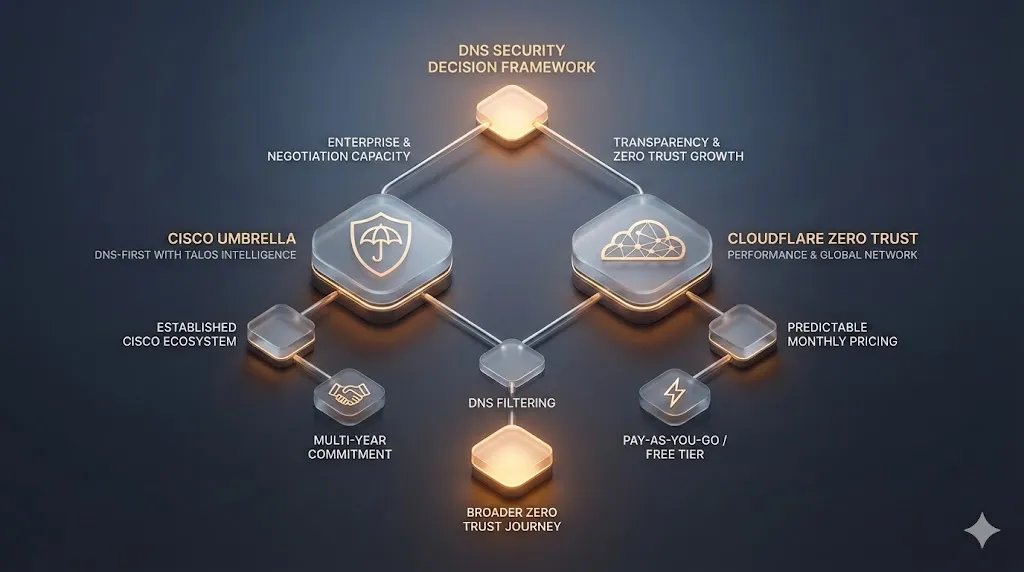
Cisco Umbrella Advantages:
- Threat Intelligence: Talos threat research integration with 35+ billion daily DNS queries
- Granular Categories: 80+ web content categories for precise filtering
- Malware Protection: Real-time protection against phishing and malware domains
- Easy Whitelisting: Simple exception management for business applications
Cloudflare for Teams Advantages:
- Performance: Global network with sub-10ms latency improvements
- Advanced Analytics: Detailed traffic analysis and user behavior insights
- Browser Isolation: Remote browser isolation for high-risk sites (Enterprise plan)
- API Integration: Extensive automation and integration capabilities
Management and Reporting
Cisco Umbrella Reporting:
- Security Dashboard: Clear threat blocking statistics and trends
- User Activity: Individual user browsing patterns and blocked attempts
- Top Categories: Most accessed and blocked website categories
- Export Capabilities: CSV reports for compliance and analysis
Cloudflare for Teams Reporting:
- Real-Time Analytics: Live traffic monitoring and threat detection
- Performance Metrics: Network performance and optimization insights
- Zero Trust Logs: Comprehensive access and security event logging
- Custom Dashboards: Configurable reporting for specific business needs
Integration Capabilities
Cisco Umbrella Integration:
- Active Directory: User and group policy management
- SIEM Platforms: Log export for security monitoring systems
- Mobile Device Management: MDM platform integration for policy deployment
- Third-Party Security: Integration with existing security stack components
Cloudflare for Teams Integration:
- Identity Providers: SSO integration with Google, Microsoft, Okta
- Zero Trust Network Access: Secure application access without VPN
- API-First Architecture: Custom integrations and automation workflows
- Development Tools: Git integration and developer workflow protection
Performance and Latency: Real-World Benchmarks
DNS filtering typically has a negligible impact on internet speed, adding less than 10 milliseconds of latency to initial page loads. Because filtering only inspects the initial domain request rather than all web traffic, bandwidth consumption remains low for both platforms.
In February 2026 tests conducted from North American locations, Cloudflare Gateway averaged approximately 12ms DNS resolution time, while Cisco Umbrella averaged approximately 15ms. Both figures are well within the threshold where users notice any difference — typical unfiltered ISP DNS resolution runs between 20ms and 50ms, so both platforms can actually improve perceived browsing speed compared to a default ISP resolver.
Platform comparison:
| Cisco Umbrella | Cloudflare Zero Trust | |
|---|---|---|
| Latency impact | +2–8ms depending on location | Often neutral or slightly improved via anycast |
| Global infrastructure | Global presence (count not published) | 330+ cities, 125+ countries |
| Redundancy | Automatic failover to backup resolvers | Multi-homed anycast with automatic failover |
| Uptime commitment | 99.9%+ | 99.9%+ |
| Bandwidth overhead | Minimal — DNS queries only | Higher with WARP client and traffic inspection enabled |
Cloudflare's advantage comes from its anycast network architecture, which routes DNS queries to the nearest data center automatically. Geographic proximity matters: users in major metro areas will see minimal latency from either platform, while users in more remote regions may see a larger gap favoring Cloudflare.
Practical guidance: Latency should not be a deciding factor for most SMBs. If your team is globally distributed or runs latency-sensitive workloads (e.g., VoIP, real-time collaboration), Cloudflare's broader network gives it a measurable edge. For small domestic teams, both platforms perform equivalently in day-to-day use.
Reliability considerations for both platforms:
- Configure a secondary DNS server as a fallback in case of service interruption
- Document your original DNS settings before deployment so you can roll back quickly if needed
- Both platforms publish real-time status pages — bookmark them for incident response
When Each Solution Wins
Choose Cisco Umbrella when:
DNS-first security is the primary goal:
- Your main objective is blocking malicious domains and inappropriate content
- Your existing security stack handles other protection layers
- You want enterprise-grade threat intelligence backed by Cisco Talos
You are already in the Cisco ecosystem:
- You have existing Cisco infrastructure or an established MSP relationship
- You are planning broader adoption of Cisco security tools
- Vendor consolidation with a single established provider is a priority
You have negotiation capacity:
- You can work through a multi-week sales or MSP procurement process
- You are open to a 12-month or multi-year commitment
- You have access to Cisco partner channels for better rates
Choose Cloudflare for Teams when:
Pricing transparency matters:
- You need predictable, published pricing without a sales process
- You want to start immediately — Cloudflare's free tier is available in minutes
- Budget planning requires fixed, known costs
You are building toward Zero Trust:
- Your applications are latency-sensitive and benefit from a global anycast network
- You are planning a broader Zero Trust security architecture (see our Zero Trust Guide for Small Business)
- You have globally distributed teams or remote-first operations
You need strong analytics and integrations:
- Detailed traffic reporting and user behavior insights are important
- You want API-driven automation or SSO integration with Google, Microsoft, or Okta
- You expect your security platform to grow in complexity over time
Consider free alternatives when:
The team is very small (1-5 people):
- Free options like Quad9 or OpenDNS may provide adequate baseline protection
- Per-user costs are disproportionate to actual risk exposure
- Internal IT capacity is too limited to manage a paid platform
Legacy environments create significant DNS risk:
- Critical business applications have hard dependencies on specific DNS configurations
- Infrastructure changes require careful coordination across multiple systems
- On-premises DNS control is required for compliance reasons
DNS filtering is not the highest-priority gap:
- Endpoint protection or email security are more pressing needs
- Existing network security infrastructure already covers DNS-layer threats
Decision Framework: Clear Triggers for Investment
Start with free options if:
- Team size: Under 5 employees with straightforward internet usage
- Budget: Very limited cybersecurity budget with higher-priority gaps to close first
- Goal: Evaluate DNS filtering before committing to a paid platform
Recommended starting point: Cloudflare Zero Trust Free (up to 50 users) or Quad9 (9.9.9.9) for set-and-forget threat blocking
Important: Cloudflare's Free tier includes no guaranteed SLA and no direct support — only community forums. For any business where DNS is critical infrastructure, a misconfiguration or outage means you are on your own until the community responds. If your team has limited IT capacity, start with the Pay-as-you-go plan ($7/user/month) instead, which includes email support.
Move to Cloudflare Zero Trust Pay-as-you-go if:
- Team size: 5-50 employees who want to self-manage without a sales process
- Budget: $70/month for a 10-person team ($7/user/month) with predictable per-user billing
- Goal: Reporting, policy management, email support, and a path to full Zero Trust without a sales process
Timeline: Start on the Free tier if under 50 users; upgrade to Pay-as-you-go when you need email support, WARP client deployment, or compliance-grade policy controls
Consider Cisco Umbrella if:
- Ecosystem: You already work with a Cisco-aligned MSP or have Cisco infrastructure
- Goal: DNS-first security with Talos threat intelligence and enterprise-grade reporting
- Capacity: You can work through a 30-60 day procurement and setup process
Timeline: 30-60 days including MSP engagement, contract, and deployment
Bring in professional services if:
- Complexity: Multi-site networks, complex application dependencies, or hybrid infrastructure
- Compliance: Regulated industries (HIPAA, PCI, financial services) requiring documented controls
- Resources: Limited internal IT capacity for deployment and ongoing policy management
Ready to get started?
Compare current pricing and start your DNS security deployment with the right plan for your team size.
NordLayer
Business VPN with zero-trust features • Starting at $8/user/month
Proton VPN
Privacy-first VPN from Proton with Swiss protection • Starting at $4.99/month
Affiliate disclosure: We may earn a commission from purchases made through these links at no additional cost to you.
Integration with Your Security Stack
Email Security Coordination
Microsoft 365 Environments:
- Both solutions complement Office 365 security without conflicts
- DNS filtering provides first-line defense before email-based threats
- Consider email security as higher priority if budget requires choosing
Google Workspace Environments:
- DNS filtering fills gaps in Google's basic security model
- Coordinate with Google Workspace security settings for optimal protection
- Cloudflare integration typically smoother with Google cloud services
See our Business Email Security Guide for a full breakdown of email protection layers.
Endpoint Protection Alignment
Windows Defender Environments:
- DNS filtering complements built-in endpoint protection effectively
- Both solutions work transparently with Windows security features
- Consider DNS filtering as first upgrade from basic endpoint protection
Business Antivirus Solutions:
- Coordinate DNS filtering with endpoint protection policies
- Avoid conflicting web filtering between DNS and endpoint solutions
- Test compatibility before full deployment
See our Endpoint Protection Guide for a comparison of business antivirus and EDR options.
Network Security Evolution
Router-Based Security:
- DNS filtering provides cloud-managed security beyond basic router features
- Configure fallback DNS servers in case of service interruptions
- Document DNS changes for future network troubleshooting
VPN Coordination:
- Ensure DNS filtering works correctly with remote worker VPN connections
- Configure split-tunnel VPNs to maintain DNS security for business traffic
- Test mobile device DNS settings with various VPN configurations
See our Small Business Cloud Security Guide for guidance on securing cloud workloads alongside DNS filtering.
DNS Security in Your Broader Cybersecurity Posture
DNS filtering is one layer in a multi-layer security model. It works best when combined with endpoint protection, email security, and identity controls — not as a standalone solution. For a structured 90-day approach that covers DNS, endpoint, email, and identity in sequence, see the Small Business Cybersecurity Roadmap.
Not sure which DNS security layer to prioritize?
The Valydex assessment maps your current security posture and recommends the right starting point for your team size and risk profile.
Run the free assessmentAlternative Solutions Comparison
Enterprise-Grade Alternatives
Zscaler Internet Access:
- Pricing: $50+ per user annually (enterprise focus)
- Best For: Large organizations requiring comprehensive web security
- Considerations: High complexity and cost for small businesses
Fortinet FortiGate Cloud:
- Pricing: $30+ per user annually
- Best For: Organizations with existing Fortinet infrastructure
- Considerations: Network appliance experience helpful for optimization
Small Business Alternatives
DNSFilter:
- Pricing: $1.50-4.00 per user monthly
- Best For: Budget-conscious organizations needing basic DNS filtering
- Considerations: Limited advanced features compared to Cisco or Cloudflare
WebTitan Cloud:
- Pricing: $1.50-3.00 per user monthly
- Best For: Education and small business environments
- Considerations: Strong content filtering focus with basic threat protection
Free alternatives
For guidance on when free DNS options (Quad9, OpenDNS, Cloudflare for Families) are appropriate versus when a paid platform is warranted, see the Decision Framework section above, which covers team size, support requirements, and compliance considerations in detail.
Cost-Benefit Analysis and ROI Calculation
DNS Security Investment Value
Cost Avoidance Benefits:
- Malware Prevention: Average small business malware cleanup costs $8,000-25,000
- Productivity Protection: Blocked inappropriate sites reduce time waste and HR issues
- Bandwidth Optimization: Filtering reduces unnecessary internet traffic costs
- Compliance Support: Documented web filtering supports cyber insurance and regulatory requirements
Quantifiable Business Impact:
- Threat Blocking: DNS filtering typically blocks multiple threats per user daily
- Performance Optimization: Cloudflare often reduces page load times through global network
- IT Support Efficiency: Automated filtering reduces malware-related support requests
- Policy Consistency: Uniform web access policies across all locations and devices
Total Cost of Ownership (TCO) Analysis
Year 1 costs (10-user business):
| Solution | Licensing | Implementation | Management | Total |
|---|---|---|---|---|
| Cisco Umbrella DNS Essentials | $3,240–$5,400 | $1,500–$6,000 | $1,000 | $5,740–$12,400 |
| Cisco Umbrella SIG | $7,920–$11,520 | $1,500–$6,000 | $1,000 | $10,420–$18,520 |
| Cloudflare Zero Trust Pay-as-you-go | $840 | $500 | $500 | $1,840 |
| Cloudflare Zero Trust Free | $0 | $200 | $400 | $600 |
Cisco licensing based on MSP street-price ranges for 2025/2026. Implementation costs reflect professional services estimates; self-managed deployments will be lower.
Year 2+ costs (10-user business):
| Solution | Annual Licensing | Annual Management | Total |
|---|---|---|---|
| Cisco Umbrella DNS Essentials | $3,240–$5,400 | $1,000 | $4,240–$6,400 |
| Cisco Umbrella SIG | $7,920–$11,520 | $1,000 | $8,920–$12,520 |
| Cloudflare Zero Trust Pay-as-you-go | $840 | $500 | $1,340 |
| Cloudflare Zero Trust Free | $0 | $400 | $400 |
Return on investment
DNS filtering is one of the lower-cost security controls available, which makes the break-even calculation straightforward for most SMBs:
- Incident avoidance: A single malware remediation event for a small business typically costs $8,000-25,000 in IT labor, downtime, and recovery — well above the annual cost of either platform
- Cyber insurance: Many insurers now ask about DNS filtering as part of underwriting; documented controls can support premium negotiations
- IT support load: Automated threat blocking reduces the volume of malware-related helpdesk tickets, freeing IT time for higher-value work
The ROI case is strongest when DNS filtering is part of a layered security posture rather than a standalone purchase. See the compliance control implementation guide for how DNS filtering maps to common insurance and regulatory requirements.
Implementation Best Practices
Pre-Deployment Planning
Network Assessment:
- Document Current DNS Configuration: Record existing settings for rollback capability
- Identify Critical Applications: List business applications requiring special network access
- Plan User Communication: Prepare explanation of changes and expected impacts
- Establish Testing Group: Select 10-20% of users for pilot deployment
Policy Development:
- Start Conservative: Begin with basic malware blocking, add categories gradually
- Business Application Whitelist: Pre-approve known business applications and services
- Exception Procedures: Establish process for users to request site access
- Regular Review Schedule: Plan monthly policy review and adjustment sessions
Deployment Best Practices
Phased Rollout Strategy:
- Week 1: IT staff and key users (troubleshooting capability)
- Week 2: Department-by-department expansion with monitoring
- Week 3: Remote workers and mobile devices
- Week 4: Full deployment with ongoing optimization
Monitoring and Optimization:
- Daily Monitoring: First week requires daily policy adjustment and user support
- Weekly Reviews: Monitor blocked sites and user feedback for policy refinement
- Monthly Analysis: Review reports for security value and policy effectiveness
- Quarterly Assessment: Evaluate costs, benefits, and potential feature expansion
User Training and Support
Initial Training Requirements:
- Policy Explanation: Why DNS filtering benefits business security
- Expected Changes: What users will and won't notice during normal browsing
- Exception Requests: How to request access to blocked business sites
- Troubleshooting: Basic steps when websites don't load correctly
Ongoing Support Preparation:
- Common Issues Documentation: Prepare solutions for typical policy conflicts
- Escalation Procedures: When to adjust policies vs. when to maintain security stance
- Performance Monitoring: Track user satisfaction and productivity impact
- Success Metrics: Document threat blocking and business value for stakeholder reporting
Troubleshooting Common Issues
DNS Resolution Problems
Symptoms:
- Websites loading slowly or not at all
- Intermittent connectivity issues
- Applications unable to connect to cloud services
Solutions:
- Check DNS Configuration: Verify proper DNS server settings on devices and routers
- Test Alternative DNS: Temporarily use backup DNS servers to isolate issues
- Review Policy Exceptions: Add necessary business applications to whitelist
- Monitor Network Performance: Verify adequate internet bandwidth for DNS traffic
False Positive Management
Symptoms:
- Legitimate business websites blocked inappropriately
- Cloud applications unable to connect through filtering
- User productivity impacted by overly restrictive policies
Solutions:
- Whitelist Business Applications: Add specific domains to approved access list
- Adjust Category Filtering: Fine-tune web category restrictions for business needs
- User Exception Requests: Establish process for reviewing and approving access requests
- Regular Policy Review: Monthly evaluation of blocked sites for business necessity
Performance Optimization
Symptoms:
- Slower web browsing or application performance
- Increased latency for cloud applications
- User complaints about internet speed
Solutions:
- Optimize DNS Server Selection: Choose geographically closest DNS filtering servers
- Reduce Logging Level: Decrease detailed logging if not required for compliance
- Bandwidth Management: Ensure adequate internet bandwidth for additional DNS traffic
- Monitor Usage Patterns: Adjust policies based on actual business application usage
Compliance and Regulatory Considerations
Industry-Specific Requirements
Healthcare (HIPAA):
- DNS filtering supports network security requirements for protected health information
- Logging capabilities provide audit trails for compliance documentation
- Web filtering prevents accidental exposure of patient data through malicious sites
Financial Services:
- DNS security addresses network protection requirements for financial data
- Threat intelligence helps prevent fraud and phishing targeting financial institutions
- Reporting capabilities support regulatory examination requirements
Professional Services:
- Client confidentiality protection through malware and phishing prevention
- Documentation of security measures for professional liability insurance
- Web filtering demonstrates due diligence for client data protection
Cyber Insurance Alignment
Common Cyber Insurance Requirements:
- Multi-factor authentication (separate from DNS filtering)
- Employee security training and awareness
- Network security measures including DNS filtering
- Regular security assessments and updates
DNS Filtering Contribution:
- Demonstrates proactive threat prevention measures
- Provides documentation of security investment and ongoing management
- Reduces likelihood of successful phishing and malware attacks
- Supports compliance with reasonable security measure requirements
See the compliance control implementation guide for how DNS filtering maps to HIPAA, PCI, and cyber insurance requirements.
Future-Proofing Your DNS Security Investment
Technology evolution and AI integrations
Both platforms have deepened AI integration by 2026, which is relevant for buyers evaluating long-term platform value:
- Cloudflare AI Gateway: Cloudflare now offers an AI Gateway layer that proxies and monitors AI API traffic (OpenAI, Anthropic, etc.), giving security teams visibility into AI tool usage across the organization — an increasingly important control as employees adopt AI assistants at work
- Cisco Talos AI: Cisco's Talos threat intelligence engine uses machine learning to identify and block AI-generated malicious domains and algorithmically generated domain attacks (DGA) in near-real-time, drawing on 35+ billion daily DNS queries for training signal
For most SMBs, these AI capabilities operate transparently in the background. The practical benefit is that both platforms are better at catching novel, AI-crafted phishing domains in 2026 than they were two years ago — without requiring any additional configuration.
Other emerging considerations:
- Encrypted DNS protocols (DoH, DoT) are increasingly common; both platforms support them, but verify your router and device configurations support the protocol your chosen platform uses
- Mobile-first workforces require consistent DNS policy enforcement across devices; both platforms handle this via their respective endpoint agents (Cisco Secure Client and Cloudflare WARP)
Scaling Considerations
Growing Team Requirements:
- 5-25 Employees: Basic DNS filtering sufficient for most requirements
- 25-100 Employees: Advanced reporting and policy management become valuable
- 100+ Employees: Enterprise features and integration capabilities essential
Technology Integration Evolution:
- Year 1: DNS filtering as standalone security improvement
- Year 2: Integration with endpoint protection and email security
- Year 3: Comprehensive security platform with centralized management
Budget Planning for Growth
Predictable Cost Scaling:
- DNS filtering costs scale linearly with employee count
- Enterprise features typically cost 2-3x basic plans per user
- Professional services for complex deployments cost 25-50% of annual licensing
ROI Improvement Over Time:
- Initial implementation costs amortized over 3-5 years
- Management efficiency improves with experience and training
- Integration benefits increase as security platform matures
Support and SLA Comparison
Support quality matters more than most buyers realize, particularly when a misconfigured DNS policy blocks a business-critical application during peak hours. The two platforms take meaningfully different approaches.
Cisco Umbrella support:
- Paid plans include access to Cisco's Technical Assistance Center (TAC), which provides 24/7 support for critical issues
- In practice, most SMBs access Umbrella support through their MSP rather than directly through Cisco — response times and quality depend heavily on the MSP's own support tier
- Self-service documentation is extensive but assumes familiarity with Cisco's product ecosystem
- Community forums are active but skew toward enterprise and MSP audiences
Cloudflare Zero Trust support:
- Free plan: Community forums and Discord only — no direct support channel, no SLA
- Pay-as-you-go: Email support with standard response times
- Enterprise: 24/7 phone support, dedicated account management, and contractual SLA guarantees
- Cloudflare's developer documentation is widely regarded as thorough and accessible for technical SMB teams
- Self-serve onboarding is strong — most basic configurations can be completed without opening a support ticket
Practical implication for SMBs: If you are buying Cisco Umbrella through an MSP, your support experience is largely determined by that MSP's responsiveness, not Cisco's. If you are self-managing, Cloudflare's documentation and community resources are generally easier to navigate for lean IT teams.
Free tier warning: Cloudflare's Free plan includes no guaranteed SLA and no direct support channel — only community forums and Discord. For a business running DNS filtering as a critical security control, this means a misconfiguration or service issue leaves you dependent on community response times. If your team lacks dedicated IT staff, the Pay-as-you-go plan ($7/user/month) is a safer starting point — it adds email support and removes the community-only constraint.
The Role of MSPs in Buying Cisco Umbrella
Most small businesses do not purchase Cisco Umbrella directly from Cisco. The product is primarily distributed through Managed Service Providers, which has practical implications for how you buy, deploy, and get support.
What this means in practice:
- Pricing is MSP-dependent: Your Umbrella quote comes from the MSP, not Cisco. Rates, contract terms, and included services vary by provider. Two businesses of the same size can pay very different amounts.
- Deployment is MSP-managed: Many MSPs bundle Umbrella into a broader managed security package. This can simplify deployment significantly — the MSP handles configuration, policy management, and monitoring on your behalf.
- Support goes through the MSP first: If something breaks, you call your MSP, not Cisco TAC. The quality of that experience depends entirely on your MSP relationship.
- Switching costs are higher: Because Umbrella is often embedded in a managed services contract, moving away from it typically means renegotiating or ending your MSP relationship as well.
For SMBs evaluating Cisco Umbrella: Ask your MSP for an itemized breakdown of what Umbrella costs within your managed services package, what is included in their support SLA, and what happens to your DNS security if you end the MSP relationship. These questions will clarify the true cost and commitment before you sign.
Cloudflare Zero Trust, by contrast, is available directly through Cloudflare's self-serve portal with no sales process required for the Pay-as-you-go plan. MSPs can also manage Cloudflare deployments, but the direct-purchase option gives SMBs more flexibility and pricing transparency.
FAQ
Cisco Umbrella vs Cloudflare DNS Security FAQs
Related Articles
More from Network Security and Zero Trust Planning

NordLayer vs Perimeter81 Comparison (2026)
Comparison framework for SMB teams choosing between managed Zero Trust access platforms.

Cloud Security Guide for SMB Teams (2026)
Implementation playbook for securing cloud workloads, SaaS usage, and identity access controls.

Zero Trust Guide for Small Business (2026)
Step-by-step model for moving from perimeter assumptions to identity and policy-driven access.
Primary references (verified 2026-02-19):
Explore Secure Network Alternatives
Use these tracked links to compare business-grade secure networking and VPN options.
Proton VPN
Privacy-first VPN from Proton with Swiss protection
Starting at $4.99/month
Affiliate disclosure: We may earn a commission from purchases made through these links at no additional cost to you.
Need help choosing the right security stack?
Run the Valydex assessment to get personalized recommendations based on your team size, risk profile, and budget.
Start Free Assessment